
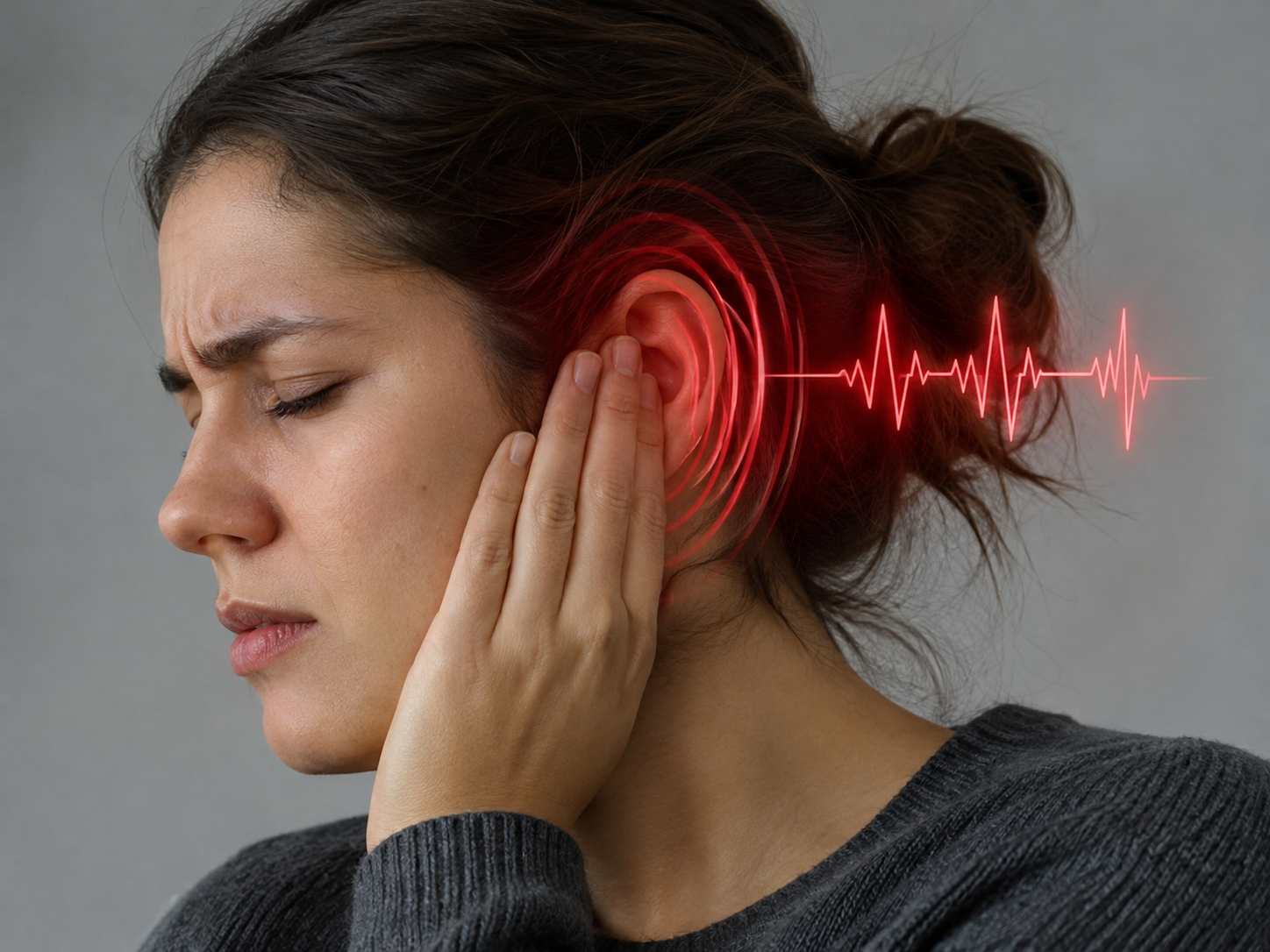
Have you ever noticed a rhythmic sound in your ear that seems to match your heartbeat? Some people describe it as a pulsing, throbbing, or whooshing noise, almost as if they can hear blood flowing through their head.
This sensation is known as pulsatile tinnitus, a less common form of tinnitus that can have several underlying causes.
Unlike typical tinnitus, which is often described as ringing or buzzing, pulsatile tinnitus usually follows a rhythmic pattern. When the sound is synchronized with the heartbeat, it may be related to blood flow in vessels near the ear.
In other cases, repetitive muscle contractions can produce clicking or pulsing sounds that resemble a heartbeat but are not actually synchronized with the pulse.
Although pulsatile tinnitus is not always a sign of a serious condition, it deserves medical evaluation because some causes involve blood vessels or other structures that require specific treatment.
In this article, we’ll explain what pulsatile tinnitus is, its possible causes, how doctors investigate it, and which specialists can help.
What is pulsatile tinnitus?
Tinnitus is the perception of sound when there is no corresponding external sound source.
Most people associate tinnitus with ringing in the ears, but it can also sound like buzzing, hissing, humming, or whistling.
Pulsatile tinnitus is different because the perceived sound has a rhythmic quality, often occurring in time with the heartbeat.
People experiencing this condition may describe:
- a heartbeat-like sound in one or both ears;
- a rhythmic whooshing or swishing noise;
- a pulsing sensation that becomes more noticeable at night;
- a sound that changes with head position or physical activity;
- a repetitive noise that seems to come from inside the head.
The sound may be constant or intermittent, and its intensity can vary throughout the day.
In some cases, pulsatile tinnitus is more noticeable when lying down or resting in a quiet environment.
How is pulsatile tinnitus different from regular tinnitus?
Non-pulsatile tinnitus is frequently associated with changes in the auditory system, including hearing loss.
Pulsatile tinnitus, however, is more likely to involve a physical source of sound, such as turbulent blood flow near the ear.
This distinction matters because the diagnostic approach can be different.
Another important concept is objective tinnitus, a rare form of tinnitus in which a sound may also be detectable by an examiner using appropriate equipment.
Some cases of pulsatile tinnitus are objective, although many are heard only by the person experiencing them.
It is also possible to have pulsatile tinnitus without noticeable hearing loss.
What causes pulsatile tinnitus?
Pulsatile tinnitus can have several causes, ranging from relatively benign anatomical variations to vascular conditions that require prompt medical attention.
Some involve blood vessels, while others are associated with muscle activity, changes in blood circulation, or structures within the middle and inner ear.
Identifying the cause is essential because treatment depends on the underlying condition.
1. Muscle contractions and middle ear disorders
Not every rhythmic sound in the ear comes from blood flow.
Sometimes, repetitive contractions of small muscles in or near the middle ear produce sounds that resemble clicking, fluttering, or pulsing.
This phenomenon may occur with middle ear myoclonus, which involves involuntary contractions of muscles such as the tensor tympani or stapedius.
Unlike vascular pulsatile tinnitus, these sounds are not necessarily synchronized with the heartbeat.
Certain movements may also influence tinnitus symptoms.
During a clinical examination, the doctor may ask the patient to:
- clench their teeth;
- open and close their mouth;
- move their jaw from side to side;
- turn or tilt their head.
Changes in the perceived sound during these movements can provide clues about possible muscular or somatosensory influences.
Conditions such as bruxism (teeth grinding or clenching), temporomandibular joint (TMJ) disorders, and neck muscle dysfunction may also contribute to certain tinnitus symptoms.
However, these conditions should not automatically be assumed to explain a sound that consistently follows the heartbeat. A vascular cause may still need to be investigated.
2. Atherosclerosis and other vascular conditions
One of the most important groups of causes of pulsatile tinnitus involves changes in blood flow near the ear.
Normally, blood flows through vessels in a relatively smooth pattern. When the flow becomes turbulent, it may generate vibrations that can be perceived as sound.
For example, atherosclerosis causes fatty deposits and other substances to accumulate in artery walls, potentially narrowing the vessels and altering blood flow.
When this occurs in arteries near the head and neck, such as the carotid arteries, it may contribute to pulsatile tinnitus.
Other vascular conditions include:
- narrowing or abnormalities of blood vessels;
- arteriovenous malformations;
- dural arteriovenous fistulas;
- certain arterial aneurysms;
- anatomical variations involving arteries close to the ear.
A dural arteriovenous fistula is an abnormal connection between arteries and veins in the protective membranes surrounding the brain.
Although uncommon, it is an important possible cause of pulsatile tinnitus because some fistulas can lead to serious complications.
During the examination, the doctor may listen for abnormal vascular sounds and assess whether the tinnitus follows the patient’s pulse.
Depending on the findings, vascular imaging may be necessary.
3. Jugular vein abnormalities
The jugular veins are major blood vessels responsible for draining blood from the brain and surrounding structures.
Changes in their anatomy or blood flow can sometimes produce pulsatile tinnitus.
Possible abnormalities include:
- venous narrowing or compression;
- enlargement of certain venous structures;
- variations in the position or shape of the jugular bulb;
- changes involving the sigmoid sinus, a large venous channel near the ear.
In some patients, the perceived sound changes when they turn their head or change body position.
These variations may suggest a venous component, although they do not establish a diagnosis on their own.
Doctors may perform specific examination maneuvers to investigate the relationship between venous blood flow and tinnitus.
Patients should not attempt to compress the blood vessels in their neck at home, as doing so may be unsafe.
4. Anemia, pregnancy, and hyperthyroidism
Not all causes of pulsatile tinnitus involve structural abnormalities in blood vessels.
Certain conditions can increase blood flow or change the way blood circulates throughout the body.
For example, severe anemia may cause the heart to work harder to deliver sufficient oxygen to tissues.
This increased circulatory activity can sometimes make blood flow more noticeable.
Other possible contributors include:
- pregnancy: hormonal changes and increased blood volume can affect circulation and may contribute to pulsatile tinnitus;
- hyperthyroidism: an overactive thyroid can increase heart rate and cardiac output, potentially making vascular sounds more noticeable;
- high blood pressure: elevated blood pressure may contribute to the perception of vascular sounds in some people, although pulsatile tinnitus does not necessarily mean someone has hypertension.
When these conditions are suspected, blood tests and other investigations may help identify the underlying problem.
5. Increased intracranial pressure
Another condition associated with pulsatile tinnitus is idiopathic intracranial hypertension (IIH).
IIH occurs when pressure inside the skull is elevated without an identifiable underlying cause such as a brain tumor.
It is more commonly diagnosed in women of reproductive age, particularly those with obesity, although it can occur in other groups.
Possible symptoms include:
- pulsatile tinnitus;
- frequent or persistent headaches;
- temporary episodes of blurred or darkened vision;
- double vision;
- visual disturbances associated with optic nerve swelling.
Because increased intracranial pressure can affect vision, early diagnosis and appropriate treatment are important.
Patients with suspected IIH may require neurological and ophthalmological evaluation, as well as imaging and other tests.
6. Tumors and structural abnormalities near the ear
In rare cases, pulsatile tinnitus may be associated with tumors or other structural abnormalities near the middle ear or skull base.
One example is a paraganglioma, sometimes referred to as a glomus tumor.
These tumors are often highly vascular and may develop near structures involved in hearing and balance.
Depending on their location and size, they may cause:
- pulsatile tinnitus;
- hearing changes;
- a feeling of fullness in the ear;
- other neurological or ear-related symptoms.
Most paragangliomas in these locations are slow-growing, but they still require specialist assessment.
Other conditions, including otosclerosis and certain middle ear abnormalities, can also be associated with tinnitus.
Is pulsatile tinnitus dangerous?
Pulsatile tinnitus is not necessarily dangerous, and some people have relatively benign explanations for the symptom.
However, it should not be dismissed as ordinary ringing in the ears.
Unlike many forms of non-pulsatile tinnitus, pulsatile tinnitus can sometimes be linked to an identifiable vascular or structural condition.
Some of these conditions are treatable, while others may require closer monitoring or medical intervention.
New, persistent, or unexplained pulse-synchronous tinnitus should be evaluated by a healthcare professional, even if it is not accompanied by pain or hearing loss.
When should you seek urgent medical attention?
Seek urgent or emergency care if pulsatile tinnitus occurs alongside:
- a sudden, extremely severe headache;
- sudden weakness, facial drooping, or difficulty speaking;
- sudden vision loss or significant visual changes;
- severe dizziness with an inability to stand or walk;
- new neurological symptoms;
- symptoms following a head or neck injury.
Sudden hearing loss also requires urgent medical assessment.
These symptoms do not necessarily indicate a dangerous vascular condition, but they may signal a medical emergency that should not be ignored.
How is pulsatile tinnitus diagnosed?
Diagnosing pulsatile tinnitus begins with a detailed medical history and physical examination.
The doctor will usually ask about the sound itself, including whether it is synchronized with the heartbeat.
Other important questions may include:
- Does the sound affect one ear or both?
- Is it constant or intermittent?
- When did it first appear?
- Does it change when you lie down or move your head?
- Does it become louder during exercise?
- Are there associated headaches, dizziness, or hearing changes?
- Do you have a history of high blood pressure, anemia, or vascular disease?
These details help determine which investigations are most appropriate.
Hearing tests
Even when pulsatile tinnitus is not accompanied by noticeable hearing loss, an audiological evaluation may be recommended.
Tests such as pure-tone audiometry and tympanometry can help assess hearing function and middle ear health.
They may also reveal abnormalities that are not obvious during everyday activities.
Blood tests
Depending on the patient’s symptoms and medical history, the doctor may request blood tests to investigate possible contributing conditions.
These may include tests for anemia or thyroid dysfunction.
Additional testing is guided by the clinical findings rather than being necessary for every patient.
Imaging tests
Imaging can play an important role in investigating pulsatile tinnitus, particularly when a vascular or structural cause is suspected.
Possible examinations include:
- magnetic resonance imaging (MRI): provides detailed images of the brain and surrounding structures;
- magnetic resonance angiography (MRA): helps assess arteries and certain vascular abnormalities;
- magnetic resonance venography (MRV): evaluates venous structures;
- computed tomography (CT): can help identify abnormalities involving bone and structures near the ear;
- CT angiography (CTA) or CT venography (CTV): provides additional information about arteries or veins.
In selected cases, more specialized vascular imaging may be needed.
The choice of examination depends on the patient’s symptoms, physical findings, and suspected cause.
Not every person with pulsatile tinnitus needs every test.
Which doctor should you see for pulsatile tinnitus?
If you hear a rhythmic sound that seems to match your heartbeat, an ear, nose, and throat (ENT) specialist, also known as an otolaryngologist, is often an appropriate starting point.
An ENT specialist can assess the ears, hearing, and nearby structures while determining whether additional investigations are necessary.
A neurotologist or an ENT specialist with expertise in tinnitus and vestibular disorders may provide a more focused evaluation.
Depending on the suspected cause, other specialists may become involved, including:
- neurologists;
- neuroradiologists;
- vascular specialists;
- cardiologists;
- audiologists;
- dentists or physical therapists when jaw or muscular factors are involved.
The goal is not simply to reduce the perceived sound, but to identify whether an underlying condition requires treatment.
Can pulsatile tinnitus be treated?
Yes. In many cases, treatment is possible, but the approach depends on what is causing the symptom.
Unlike some forms of non-pulsatile tinnitus, pulsatile tinnitus may have a specific underlying condition that can be identified and addressed.
For example:
- anemia may require treatment of the underlying deficiency or disease.
- thyroid disorders may improve with appropriate medical management.
- certain vascular abnormalities may require monitoring or specialist procedures.
- middle ear muscle disorders may benefit from targeted treatment.
- conditions involving increased intracranial pressure require specific medical management.
When the underlying cause can be treated successfully, the pulsatile sound may decrease or disappear.
However, complete resolution is not guaranteed.
For patients whose tinnitus persists despite appropriate investigation and treatment, supportive strategies may help reduce its impact on sleep, concentration, and quality of life.
These may include counseling, sound-based approaches, and cognitive behavioral therapy when appropriate.
Treatment should always be individualized.
Frequently asked questions
Why can I hear my heartbeat in my ear?
Hearing a sound that follows your heartbeat may be a sign of pulsatile tinnitus.
The sensation can occur when blood flow in vessels near the ear becomes audible or when certain anatomical or medical conditions affect circulation.
Because some causes require medical attention, persistent heartbeat-like sounds should be evaluated by a healthcare professional.
Can pulsatile tinnitus go away on its own?
Sometimes, pulsatile tinnitus improves or disappears, particularly when it is related to a temporary condition.
However, symptoms that resolve spontaneously do not necessarily rule out an underlying medical problem.
If the sound is new, recurring, or clearly synchronized with your heartbeat, medical evaluation is recommended.
Is pulsatile tinnitus always caused by a blood vessel problem?
No. Although vascular causes are particularly important in pulse-synchronous tinnitus, rhythmic sounds can also result from muscle contractions or other conditions.
A detailed assessment helps distinguish vascular pulsations from other repetitive ear sounds.
Can stress or anxiety cause pulsatile tinnitus?
Stress and anxiety can make tinnitus more noticeable and distressing.
However, they should not automatically be considered the underlying cause of a sound that consistently follows the heartbeat.
If the sound is genuinely pulse-synchronous, medical evaluation is important to investigate possible vascular or structural explanations.
Why is pulsatile tinnitus louder at night?
Pulsatile tinnitus may seem louder at night because the surrounding environment is quieter.
When there is less background noise, internal sounds can become more noticeable.
Body position may also influence certain forms of pulsatile tinnitus, particularly those involving venous blood flow.
Can high blood pressure cause pulsatile tinnitus?
High blood pressure may contribute to pulsatile tinnitus in some individuals, but it is not the only possible explanation.
A heartbeat-like sound in the ear does not establish a diagnosis of hypertension.
Blood pressure measurement and an appropriate medical assessment are necessary.
Does pulsatile tinnitus affect only one ear?
No. Pulsatile tinnitus can occur in one ear or both.
When it affects only one ear, the doctor may pay particular attention to vascular and structural conditions on that side.
However, the location of the sound alone cannot determine its cause.
What is the best treatment for pulsatile tinnitus?
There is no single treatment that works for everyone.
The most effective approach depends on identifying the underlying cause.
Some patients benefit from medication or treatment of a systemic condition, while others may require specialized procedures or supportive tinnitus management.