
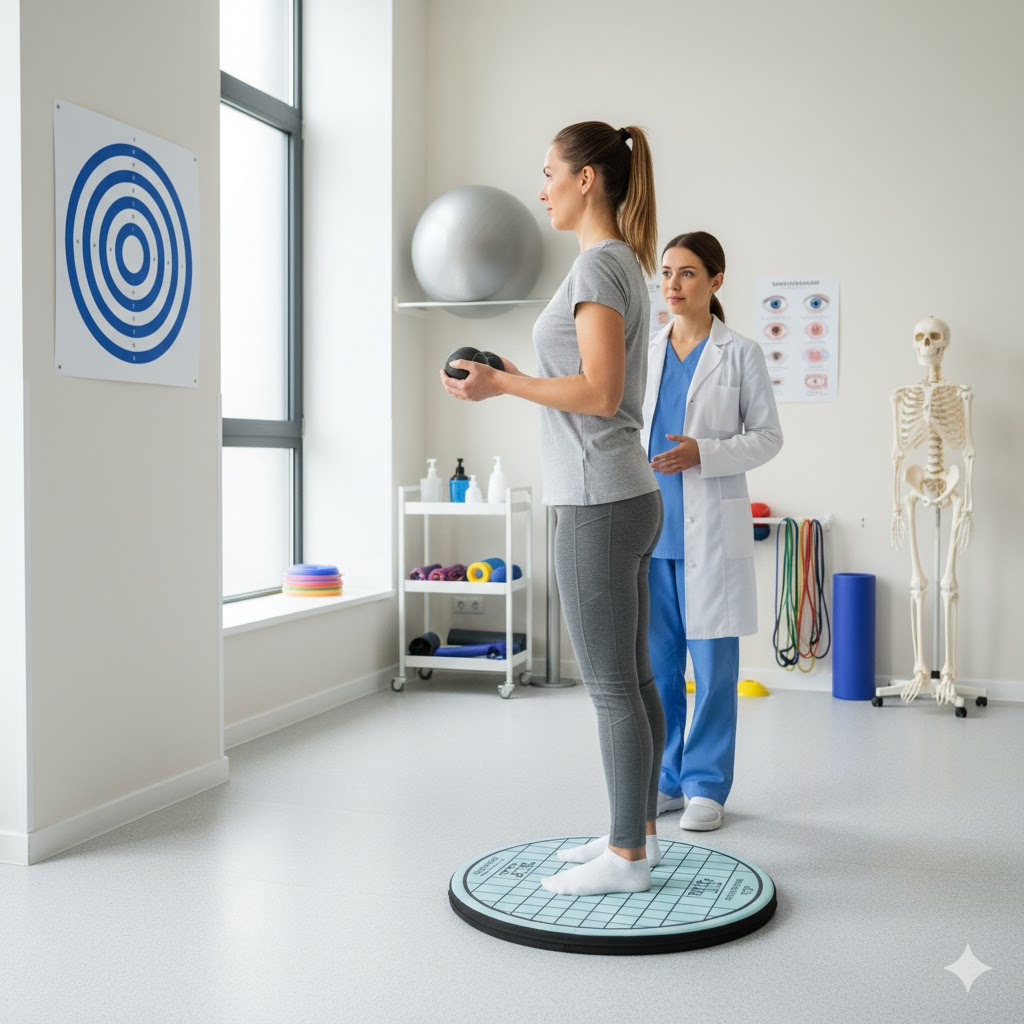
Vestibular rehabilitation therapy is a set of exercises and techniques designed to improve balance and coordination, especially in dysfunctions and disorders that cause dizziness. This treatment can be performed by otolaryngologists, audiologists, and specialized physical therapists.
Dizziness is a symptom associated with several medical conditions in which sensory balance is impaired, leading to sensations such as spinning (vertigo), falling, blurred vision, or unsteadiness.
In general terms, sensory balance is the ability to maintain stable posture and body orientation, relying on muscle control and a complex interaction between sensory organs and the brain.
This is where vestibular rehabilitation therapy comes in — a series of guided exercises to improve the function of vestibular system structures and, consequently, enhance the patient’s balance.
In this article, I explain in detail how this type of therapy works, its purpose, indications, and the benefits it offers for treating balance-related conditions.
- What is vestibular rehabilitation therapy?
- What is the vestibular system and how does it influence balance?
- When is vestibular rehabilitation therapy recommended?
- Can vestibular rehabilitation therapy help with tinnitus?
- How is vestibular rehabilitation therapy performed?
What is vestibular rehabilitation therapy?
Vestibular rehabilitation therapy consists of exercises and practices that aim to improve the function and communication among the structures of the vestibular system by stimulating its “plasticity” — its ability to adapt to specific and repeated stimuli and compensate for lost functions to achieve recovery.
It is important to highlight that this therapy is completely different from repositioning maneuvers used to treat BPPV (Benign Paroxysmal Positional Vertigo).
Repositioning maneuvers — such as the Epley maneuver — are performed only by ENT doctors in the clinic, and most patients improve with a single session.
Vestibular rehabilitation therapy has a physiotherapeutic approach and involves a routine of exercises aimed at stimulating and enhancing vestibular functions.
What is the vestibular system and how does it influence balance?
The vestibular system is composed of different structures. Among them is the labyrinth, located in the inner ear and formed by three main parts: the semicircular canals, the saccule, and the utricle. It also includes the vestibular nerve — responsible for sending information to the central nervous system — and brain structures such as the brainstem.
The semicircular canals are three fluid-filled tubes (endolymph) arranged in different spatial planes, while the saccule and utricle are sensory structures containing tiny calcium carbonate crystals (otoliths).
Through these crystals and fluid movements, sensory cells detect body accelerations and changes in head position relative to gravity and convert them into nerve impulses. These impulses travel through the vestibular nerve to the brainstem and cerebellum, where they are processed and coordinated to generate appropriate motor responses.
When is vestibular rehabilitation therapy recommended?
Vestibular rehabilitation therapy can be recommended for a wide range of conditions, especially those affecting the structures or functions responsible for balance — such as the labyrinth or cerebellum in the brain.
Examples include:
- vestibular neuritis (inflammation of the vestibular nerve) with persistent symptoms after infection;
- labyrinthitis with residual imbalance;
- patients who have suffered a stroke affecting balance-related brain structures.
In such cases, patients may experience persistent severe dizziness, instability, and difficulty performing daily activities even after treating the main cause — requiring a rehabilitation approach.
The indication for vestibular rehabilitation therapy must always be made by otolaryngologists or neurotologists — the only professionals qualified to assess diagnostic results and personalize therapy protocols according to each patient’s vestibular dysfunction.
Can vestibular rehabilitation therapy help with tinnitus?
Because vestibular rehabilitation therapy focuses on disorders of the vestibular system — aiming to restore balance and spatial orientation — it is not primarily indicated for tinnitus treatment.
However, due to the close relationship between structures of the inner ear, tinnitus may occur in conditions where dizziness is also present.
Thus, although prescribed mainly to treat dizziness, vestibular rehabilitation therapy may produce indirect positive effects on tinnitus by improving overall vestibular and inner ear function.
Additionally, by restoring balance and reducing the instability associated with vestibular disorders, the therapy can also decrease stress and anxiety — factors known to worsen the perception of tinnitus.
How is vestibular rehabilitation therapy performed?
Vestibular rehabilitation therapy is carried out after a detailed evaluation of the patient’s symptoms, medical history, physical examination, and specific vestibular tests.
Based on this evaluation, a personalized treatment plan is developed, combining different exercises and techniques.
Common components include:
- gaze stabilization exercises: keeping the eyes fixed on a stationary target while moving the head, improving visual performance during motion;
- balance training exercises: challenging the patient’s balance in controlled environments to enhance everyday stability;
- habituation exercises: involving repeated exposure to movements or positions that trigger vestibular symptoms, such as sitting up and standing repeatedly (over time, this reduces both the frequency and intensity of symptoms).
Vestibular rehabilitation therapy is essential — when properly indicated — for treating dizziness-causing dysfunctions. It must always be performed by specialized professionals, who can adequately stimulate the vestibular system and rehabilitate sensory and motor functions.
With detailed assessments and customized exercises, this therapy offers a comprehensive approach to improving the quality of life of patients who suffer from dizziness.