
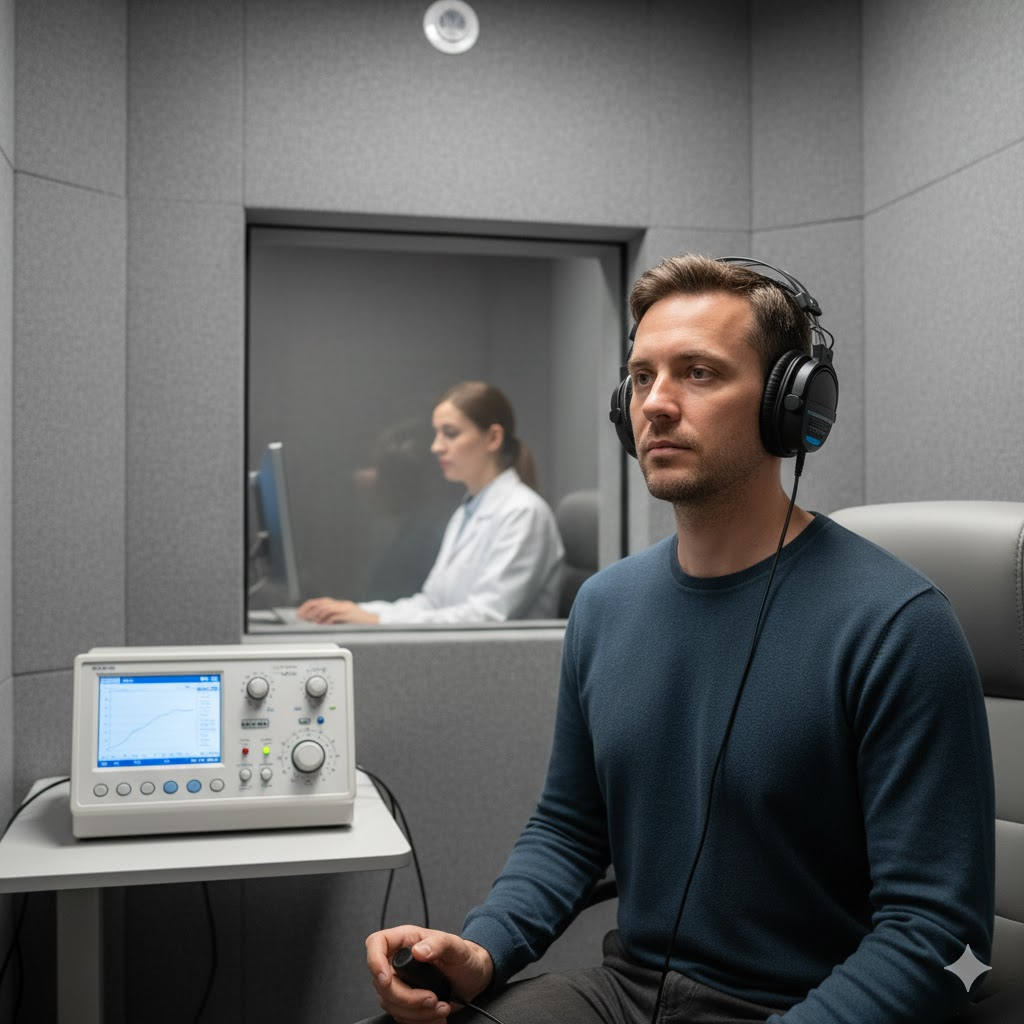
There is no specific test capable of diagnosing labyrinthitis — or any other cause of dizziness — on its own. Exams are just part of the diagnostic process, which also depends on medical evaluation and, most importantly, the patient’s own report. It’s not uncommon for people with vestibular disorders to have completely normal test results.
Labyrinthitis is a medical condition that affects the inner ear, specifically the labyrinth, a structure responsible for balance and hearing.
It is an infectious condition, usually accompanied by symptoms such as dizziness, vertigo, nausea, imbalance, and auditory changes like hearing loss and tinnitus. However, many other disorders share similar symptoms — which makes diagnosis challenging.
Moreover, laboratory tests and imaging, when used alone, are often unable to determine whether labyrinthitis is present or has occurred in the past. That’s why a detailed health history and careful clinical evaluation are essential for diagnosis.
Still, exams are valuable tools — they help specialists understand the condition in depth and rule out other possible causes. Below, I answer the most frequent questions about tests used when labyrinthitis is suspected. Check it out!
- Which exams help diagnose labyrinthitis?
- Do tests show everything I need?
- I have dizziness but normal test results — what now?
Which exams help diagnose labyrinthitis?
Because vestibular disorders — including labyrinthitis — typically cause very similar symptoms, the goal of diagnostic exams is often more about ruling out other conditions and identifying associated factors than pinpointing the main cause.
This is essential, since dizziness, vertigo, tinnitus, and hearing loss are common in a wide range of health conditions.
Audiometry
Audiometry is fundamental not only to assess hearing loss, but also to compare both ears, since labyrinthitis often affects hearing in just one ear.
Immittance Testing
Immittance testing (or impedance testing) provides detailed information about the middle ear and the Eustachian tube, helping identify whether fluid in the middle ear may be leading to labyrinthitis.
Blood Tests
Blood work may help detect signs of infection that could indicate labyrinthitis.
Videonystagmography (VNG) or Electronystagmography (ENG)
ENG and VNG are key exams for evaluating neurological structures involved in balance and part of the labyrinth responsible for equilibrium.
During these tests, electrodes (ENG) or cameras (VNG) record eye movements in response to vestibular and visual stimuli — such as tracking a moving target or thermal stimulation of the labyrinth.
Because they assess multiple components of the vestibular system, these tests can detect abnormalities associated with labyrinthitis, such as spontaneous nystagmus and asymmetry between the two sides of the labyrinth.
Do tests show everything I need?
While exams are important — they provide crucial data about the vestibular and auditory system — they rarely offer all the answers on their own.
As mentioned earlier, diagnosis depends largely on the patient’s narrative, combined with medical evaluation, history, and exam results.
Therefore, being precise and detailed during the consultation makes all the difference. Pay attention to your symptoms.
- How does your dizziness feel?
- When does it occur?
- Are there triggers?
- Are there additional symptoms — even subtle ones?
Every detail matters.
I have dizziness but normal test results — what now?
It’s common for patients to arrive with several normal exam results but persistent dizziness. In these situations, guidance from a specialized doctor is even more important — ideally an ENT focused on vestibular and auditory disorders).
As with other infectious disorders, labyrinthitis treatment typically includes rest, hydration, medications for symptom relief, and treatment of the underlying cause — and rehabilitation if sequelae remain. But that only applies if the diagnosis truly is labyrinthitis.
Many other conditions can cause dizziness as the main symptom, each requiring its own diagnostic and therapeutic approach.
Now you know that exams support the diagnosis of labyrinthitis — but they are not definitive. And in every case, treatment must be personalized and guided by a specialist.