
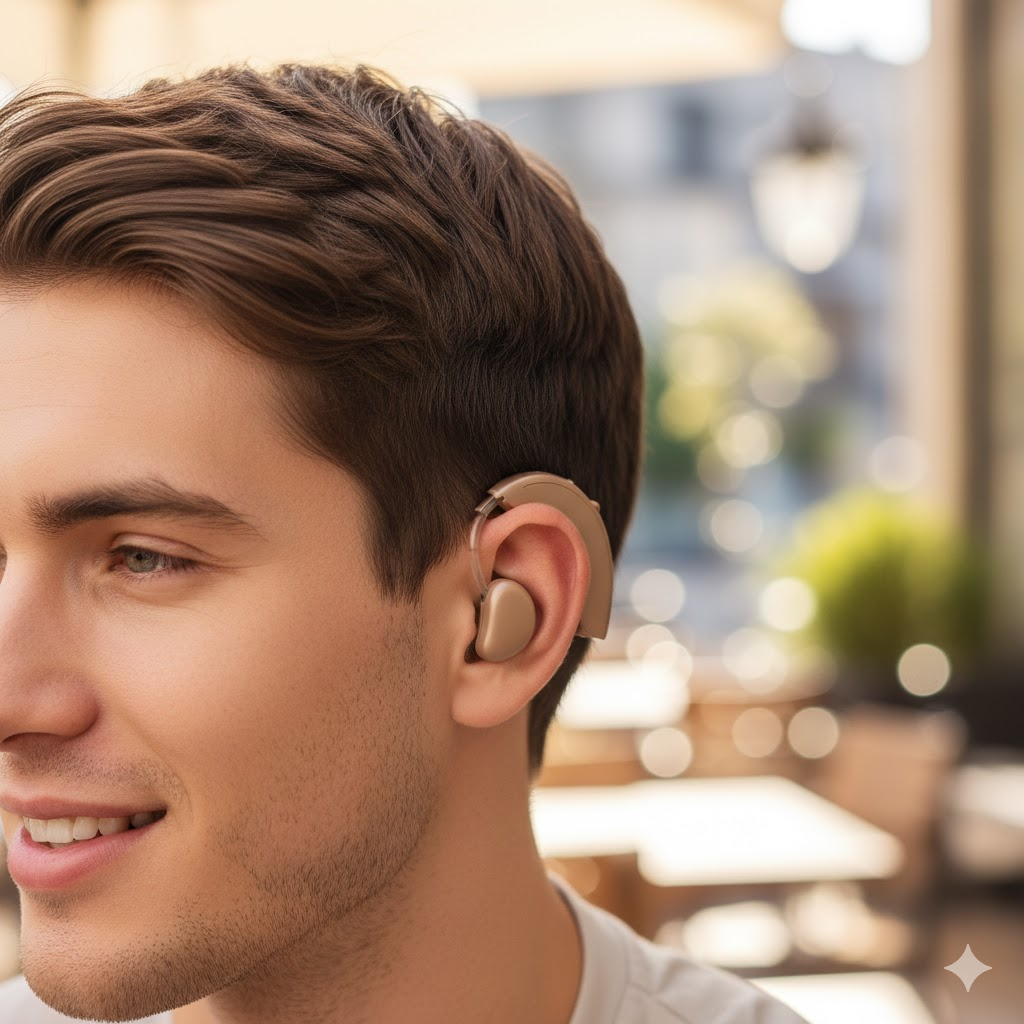
Hearing aids are essential devices for people with hearing loss, tinnitus, and hyperacusis. Their purchase must be guided by an otolaryngologist or audiologist, and understanding how they work and the available options is also important.
For people experiencing hearing loss, hearing aids are fundamental for maintaining productivity and quality of life.
These devices are designed to improve hearing in cases of mild, moderate, or severe loss. Essentially, they capture sound from the environment, amplify it, and transmit it to the ear, helping the user perceive and understand sounds more clearly.
Despite their apparent simplicity, they feature sophisticated systems developed to not only improve hearing ability, but also the overall quality of life of those dealing with different auditory disorders.
In this article, I explain how hearing aids work, the different types available on the market, and who they are recommended for. Follow along with me!
- How do hearing aids work?
- What are the main types of hearing aids?
- Who should use hearing aids?
- What should you know before buying a hearing aid?
- How much does a hearing aid cost?
How do hearing aids work?
Hearing aids are made up of several components and operate in a sophisticated way, aiming to restore hearing ability in those suffering from some degree of hearing loss or associated symptoms, such as tinnitus.
In these devices, the microphone captures sound vibrations from the surrounding environment, converting them into electrical signals with the help of the amplifier — the component responsible for boosting signal intensity.
Once amplified, the electrical signals are sent to the receiver, which converts them back into audible sounds, making them not only louder but also clearer and easier to understand for users with limited hearing.
Most hearing aids are powered by a battery, which provides the necessary energy for continuous operation.
What are the main types of hearing aids?
There are several types of hearing aids available, each with specific formats and technologies. Below are the main options on the market today:
In-the-Ear Hearing Aids (ITE)
ITE hearing aids are custom-made to fit inside the ear, resembling wireless earbuds — meaning they are visible externally and tend to be larger, which often makes them easier to handle.
They are recommended for different degrees of hearing loss, from mild to severe.
Behind-the-Ear Hearing Aids (BTE)
These are the most well-known models. In BTE devices, the microphone and amplifier sit behind the ear, connected to a custom earmold that fits inside the ear canal.
They are more discreet than ITE devices and suitable for mild, moderate, and severe hearing loss.
In-the-Canal Hearing Aids (ITC)
Similar in shape to ITE models, but smaller.
ITCs fit partially inside the ear canal, making them less visible and more discreet.
They are recommended for mild to moderate hearing loss and offer a balance between visibility and performance.
Completely-in-Canal Hearing Aids (CIC)
CIC models are the most discreet ones — they sit completely inside the ear canal and are almost invisible.
Like ITCs, they are suitable for mild to moderate hearing loss and can provide a more natural hearing experience due to their close proximity to the eardrum.
Who should use hearing aids?
While hearing aids are particularly recommended for moderate to severe hearing loss, they benefit a wide range of cases, including mild loss and other auditory alterations.
For people with tinnitus — the perception of sound without an external source — hearing aids help not only by correcting hearing loss but also by reducing tinnitus perception, increasing everyday comfort.
They are also valuable in sound therapy, often used for individuals with increased sensitivity to moderate-intensity sounds, a condition known as hyperacusis.
What should you know before buying a hearing aid?
First and foremost: different technologies and models have specific applications, and the devices require personalized adjustments.
Therefore, hearing aids must only be purchased under the recommendation of an otolaryngologist after proper medical evaluation.
It is also important to test the device before buying it. Most specialized stores offer a trial period.
You can also seek advice from people who already use hearing aids — especially those who have tried different models. Hearing from others can boost confidence, ease adaptation, and help break stigmas — wearing a device should never be a source of embarrassment.
Keep in mind that this technology evolves constantly — newer models usually provide better features and performance. You may want to upgrade over time.
How much does a hearing aid cost?
Prices can vary considerably depending on factors such as model, technology level, additional features, brand, and where you purchase it.
In Brazil, it’s important to recognize that hearing aids can represent a significant investment. Additionally, they require maintenance, technical support, and follow-up from healthcare professionals.
However, Brazil’s Unified Health System (SUS) provides hearing aids free of charge through its hearing health program. Visit a public health unit in your region to check the requirements to join the waiting list.
To conclude: buying a hearing aid should never be done freely or without proper guidance. A specialist — otolaryngologist, otoneurologist, and audiologist — must evaluate the patient and prescribe the correct model and technology.